Judy found a post advertised in the Computer Press for a 6-month contract in the Postgraduate School of Electrical and Electronic Engineering at the University of Bradford, where David had been offered a job in the Computer Centre. Better than nothing.
In olden times, Universities were intellectually exciting places to be. You could do what you liked, and if you did like, the research opportunities were only bounded by your imagination and energy. Some people, to their eternal shame, took advantage of the freedom, and grew the most outstanding roses at home. Others worked their hearts out utterly committed to their research interests. Judy was one of them.
She arrived in the Acoustics Laboratory at the University of Bradford, to find that Rex Leadham, her project supervisor was unaccountably detained. He was sailing back to the UK on his yacht after attending a conference in Sweden. His research student had sailed across with him, but had positively refused to accompany him back. A storm arose during the return journey. Rex eventually landed in Scotland, and made his way down the coast later than expected.
Judy registered at the Computer Centre. She found that her project was based on a Computer language she had never used before, and set about learning it. The Acoustics Lab was populated by very friendly, but strange, research students who gave her an idea of what Rex wanted her to do, and she went for it with characteristic enthusiasm. When Rex eventually turned up, she had completed a lot of the work that she was appointed to do. However, there were plenty more research projects in the department, and she soon became familiar with problems in acoustics and helped with the programming. 3 months into her contract she knew that in another 3 months she would be out of work. This was a cause of anxiety. She was greatly relieved when another research project needed a competent programmer. She was taken on for a further 6 months. Then another 6 months, then another. She was good. She was an asset to the department. The head of Department, Prof. Howson, persuaded the University to set up a post just for her “To assist in the development of computer software at the request of Prof Howson.” It couldn’t happen now.
However, she was still an unqualified success and thought she really ought to get a degree. She signed on for an Open University Maths degree. She did not have a TV at home, and went round to Aunt Edith’s each week to watch the broadcast programmes. She completed the first year successfully. The Summer School was difficult for her. She found the other students were pretentious. They had come to show off and commit adultery. This was not her idea of fun, but she survived. In the second year she chose an option relating to algorithms. After due consideration, she decided that her Tutor knew considerably less about algorithm development than she did. Would you ever believe it? She sent her a rude letter saying as much and decided it was a waste of her time continuing.
In 1975 she had enough of travelling between Leeds and Bradford each day, and looked for a house in Bradford. Her house in Leeds was wonderful – it even had a stream running through the garden. The specification of the new house was:
- To be within walking distance of the University
- Have a large garden
- Not cost a fortune
- Be withing reasonable distance of a school and Cub Pack
Nothing in Bradford matched all those requirements, but she came across the most wonderful house about 2 miles from the University with a very large well designed garden. The garden had once been a spoil heap. There had been a lot of iron and coal mining in the area in the 1850’s. The house was built for a market gardener who designed the garden with great skill. It did not have a stream, but it did have mature trees, an air raid shelter and, she found out later, a most excellent neighbour. She loved it. Moving in was complicated, as the lady selling the house had difficulty moving to her new house in Harrogate. The family camped out for 3 months in her parents’ house.
She was sat in the front room of the new house with everything in boxes and no carpets on the floor when the Methodist Minister called round to welcome her. This was no less a person than the admirable FS Clarke. She was equally distant from 4 Methodist chapels in the area, but she was welcome to attend his church in Wibsey – about 1 mile away. She liked him immediately. He was completely transparent and awkward. A twin soul. Within 6 months she was taking a young people’s Sunday School class which included Susanna Clarke, the Minister’s eldest child. Who? Only Suzanna (née Susanna) Clarke author of Jonathan Strange and Mr Norrell. In the same class was Susan Whincup who metamorphosed into Susan Fassbender famous for having been once on Top of the Pops with her band. They both have Wikipedia entries.
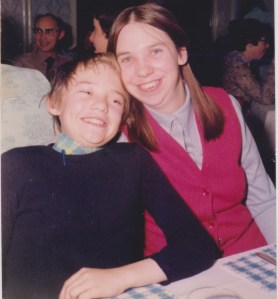
At this period she also doubled up as Social Worker. Susan was a troubled young girl, who caused her family no end of anxiety. She ran away from home, and turned up at Judy’s house. Phil was turfed out of bed to give her somewhere to sleep. I can’t remember where he ended up sleeping. In the bath?
Phil loved school, and school loved him. They were a little concerned that he seemed to have inherited the physical awkwardness of his mother. They recommend that he should be examined by a rheumatologist, but there was no evidence of any inherited abnormality. He had quickly made friends when they moved from Leeds to Bradford, and joined things with all the enthusiasm of an 8 year old. Judy was more like a big sister than a mother, but she was a good big sister. He was introduced at an early age to probability theory – playing crib.
The work kept coming in. Once she had a general purpose post in the department, they fitted her up with her own office. She was heavily involved in a project run by Dr (later Prof) Watson, monitoring the distortion of radio signals in different weather conditions. If you know that it is raining, and that the rain drops are such and such a size, and the direction and speed of the wind, you can have a go at predicting how radio signals will be distorted. You can then compensate for it. Different types of snow exhibit most interesting effects. On Oxenhope Moor just outside Bradford, the University had use of an ex-RAF Radio Station. Dr Watson was a research hero. Or obsessive. One Christmas morning it was snowing to everyone’s delight, but particularly to his. He left his wife and 3 children at home and went up to the Radio Station to ensure that the recording equipment was functioning correctly, and to observe whether the radio signals were behaving as he expected. One the best Christmases of his life.
Judy’s involvement in the project was to control the recording equipment on the Moor using a PDP8 computer. That will mean something to some people who will get all misty-eyed at the memory.
Judy was involved in other research projects as well. She developed an open advisory service each morning for all members of the department, staff and students. In the afternoon she would work on the Radio Signal project. In the mornings, students and members of staff would form an orderly queue outside her office, and she would see them in turn, looking at their attempts to program with great patience, and helping them to structure their programs rationally.
Many of the students in the Post Graduate Department were from the Middle East and from the Indian sub-continent. They had friends in other departments of the University, so soon enough Judy was advising the University Near-Eastern sub-culture on projects in Civil Engineering, Chemical Engineering, Control Engineering, Structural Engineering and even Business Studies. The Professor of Civil Engineering however would ring her and ask her to come over to his office to see him. The excellence of his software development must have been known all over the world. Judy was always polite, would never laugh at other people’s mistakes or incomprehension, and was an ideal advisor. She made a substantial contribution to many PhD theses. A few of the students were uncomfortable being in a room with a woman on her own, but she took no offence, and they managed to come to terms with the enormity of being assisted by a woman.
Judy made a half-hearted attempt to learn Arabic, and acquired a teach-yourself book with example sentences like “The Customs official is a Jew” and “Mohammed the great Sheikh is ill“, but the opportunity to slip these phrases into ordinary conversation prevented her from making much progress. She turned down the offer of a job in Mosul University. Phew!
The Advisory Service that Judy was offering was contrary to all that was right and reasonable, since David was in charge of the official Computing Centre advisory service manned by 6 or 8 Computer Officers. He also enjoyed looking over people’s programs, finding errors and helping them to think through how to express the problems they needed to solve. He enjoyed the competition. His tolerance may well have been nourished by the thought that the head of the Computer Centre would be really annoyed if he found out about Judy’s subversive advisory activities. That would please both of them. The official service was organised so that for 6 hours each day the advisory desk would be manned by different Computer Officers in turn. People making use of it would see a different person each time, while Judy saw the same people day after day. She soon spotted a repeated pattern of problems that kept cropping up – Engineers from many different Departments needed to produce graphs of their experimental results. They struggled, negotiating the difficulties of the standard graphics library. Each of them made the same mistakes and none of them did a good job of it. This was a common feature in the departmental projects she was directly involved in as well. To cut down on the demands that were made on her, she started to develop a family of common solutions to different problems. It had to be capable of producing graphs suitable for inclusion in a University of Bradford thesis, be exceptionally easy to use, and impossible to fail. Anyone trying to draw a graph of their data would get some useful output. “A prize every time“. Her software would follow the principle of least astonishment. These were they days when you submitted a deck of punched cards one day, and had to wait until the next day to get your results out. The graphs were drawn on the one and only University graph plotter, economising on the amount of paper used. It was the time before screen graphics.
 jbrip
jbrip 