Back at school, she learned how to play the system. No one at the school seemed to know what she should and should not do. She therefore took it upon herself to inform them that she should not do PE or games, and that she had missed so much History that it wasn’t worth trying to start again.
One of her regrets was that she had missed a year of Latin, and just sat in on the lessons, without being invited to get up to speed. She was always very interested in words and their meaning, picked up enough vocabulary to relate words to their roots, but did not study to examination level.
She did well enough at O Level to enter the 6th Form which she loved. Grandma Whiteley encouraged her to go to University “because you’ll never get married and will need to earn your living”. Well, she got one of them right. She was taught by Zol Grant, an inspirational Chemistry teacher who believed that time studying other subjects was time wasted. If you started on Chemistry A Level you did not just pass, but you passed with distinction. She admired that single-minded commitment, even if she failed to understand his obsession with Chemistry.
At about this time she attended the weekly Orchestral Concerts in Leeds Town Hall, and developed a good knowledge of European Classical music. Much later in life she was delighted to discover that Alan Bennett had also attended these concerts while at school and wrote about them with great pride and thanks.
After getting a few A Level passes she attended the local Technical College for a further year to get enough qualifications to go to University. Her objective was to leave home, and she enrolled on a new Mathematics course at the University of Manchester College of Science and Technology (UMIST). Going to University was wonderful. She started an entirely new life.
For the first time in her life she could do what she wanted. She became Judy, and was determined to be her own woman. She was a committed English member of the Methodist International House – founded to provide a welcoming environment for students from all over the world and of all faiths. Here she met all kinds of other young people who were earnest believers in social justice, progress, and simple fun. Uncomplicated Methodist fun.
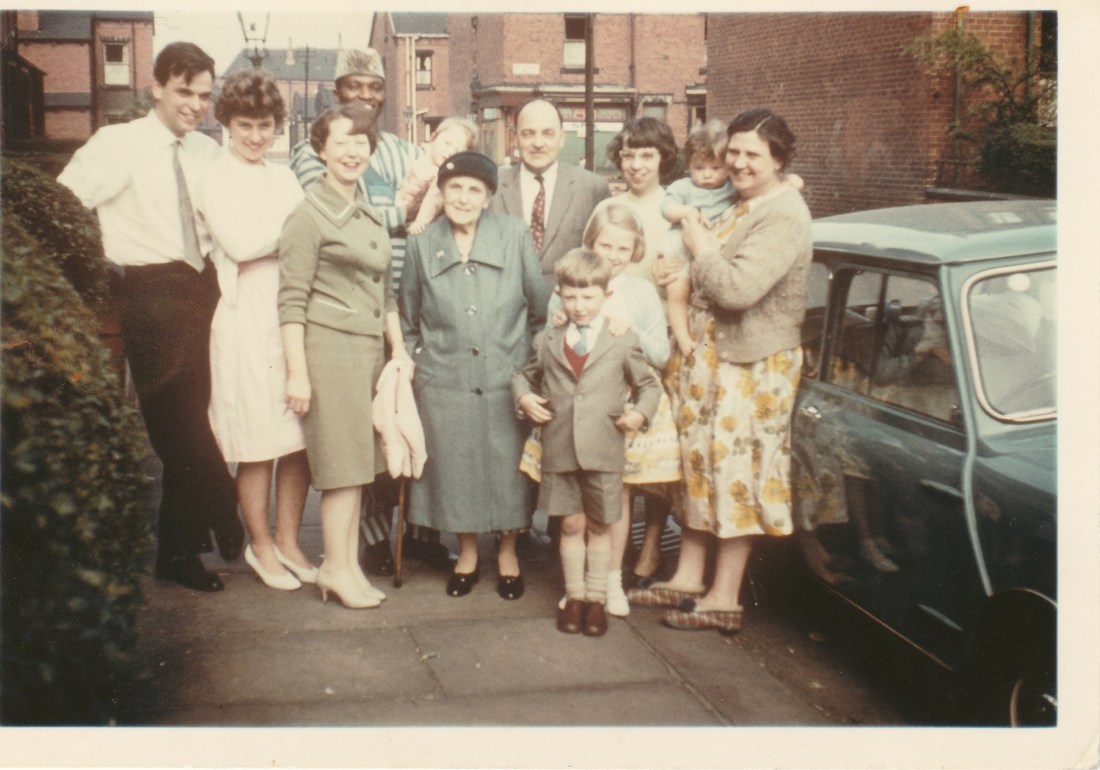
She joined the Methodist Society at the University, and soon became a member of the Committee. In 1960, much of the property in Manchester was in very poor condition, and a huge Council led programme of slum clearance was under way. Meanwhile work parties of enthusiastic students were patching up some of the serviceable properties, moving into still-inhabited houses and redecorating them. She enjoyed being a part of this, believing it’s better to make the best of a bad job rather than to rage at the dreadfulness of the situation. This was the underlying principle of the rest of her life.
In the interest of simple justice she joined in a revolt at MIH of some of the English residents who were dismayed at the way the Manageress, Miss Maltby, treated the black African residents. Miss Maltby was the daughter of the illustrious (in Methodist circles) Dr. William Russell Maltby. A name you could still conjure with in 1960. She would put her arm around the huge shoulder of a black African and talk to him as to a little child. She signed a letter of protest to the governors of MIH, and received a letter in the Summer vacation informing her that she should not return in September.
This did not matter as much as it might have done, since she answered an advertisement in the Methodist Recorder placed by Miss Whitehead (St. Miss Whitehead) for a lodger to share in a flat at 109 Withington Rd. Miss Whitehead was a Dickensian Good Person. The only landlady in Manchester who invited her tenants occasionally round for Sunday dinner. Miss Whitehead attended Withington Rd Methodist Chapel as had her fathers before her. Co-tenants in a flat share were Christine Appleton from Bingley and Kathleen Gardner from Wakefield. Kathleen was terrific. She had Judy’s mother’s ability to organise a household, used good Yorkshire plain speaking and common sense, but with a sense of fun.
In her second year this previously shy, unassuming social non-entity took up the post of recruiting manager for the Methodist Society (MethSoc), and she went for it with total commitment. In September 1961 she went round in her leathers on her scooter to an all-male Hall of Residence and invited David Butland (remember that name) to join the Methodist Society on the following Sunday at Oxford Place Methodist Chapel near the University. He remembers the leathers, she remembered the gown he was wearing, about to go into Dinner.
But what about the Maths? Ah, there was a bit of a problem on that front. With all the socially responsible work and the other essential activities of University life in the Students’ Union, she found the Maths lectures comprehensively unengaging. She had come to University to study Mathematics because she enjoyed problem solving.
Some of the courses were OK – she loved Mathematical Analysis, but other lecturers were not as good at problem solving as at manipulating symbols without reference to the real world. Since their lectures were of no interest, she would take the Guardian Cryptic Crossword into lectures and make best use of the time trying to complete it in the hour. It was lecture time well spent when she could do it.
This was a strategic error. Other students learned how to answer examination questions, she regarded this as cheating. However, she specialised in problem solving beyond the daily Guardian Crossword. She started to play cards with characteristic commitment.
MethSoc was a pleasure and a joy. The big series of meetings was on Sundays, when students from all kinds of backgrounds came together for discussion groups, then a tea, then Evening Service, then an invited eminent speaker. All kinds of people attended – fun people – good people. Young men and women who suffered from Existentialism, 4-square Gospellers, Christian Socialists, ultra rationalists. All of them with a sense of Responsibility, without being too precious. Judy was at the heart of the organisation, and made good friends there. It was a good time to be alive. She was witty and weird. She was out-going as never before nor since.
There were 3 other centres of social activity: The Students’ Union, where she just assumed a spectator role, 109 Withington Rd, where the card players met to play cards through the night, and 147(?) Birch Hall Lane, where Chris Houghton, Chris Paice, David Lavis, and later David Butland (remember him?) shared a flat – all members of MethSoc. Social activities at Birch Hall Lane tended to be a bit intense, as the Existentialists were wracked with despair and a desire for Authenticity.. David Butland was mercifully unaffected by this sense of alienation. He had tried it once, rather like smoking, and decided it wasn’t half as good as people had made out. He preferred PG Wodehouse to Simone de Beauvoir. Much sounder on the human predicament.
Judy had started on an Honours Maths degree. By the end of her second year this was downgraded to an Ordinary Degree, and in her final year she had lost interest. There were too many other things to do. Like …
David Butland had fallen in love. He wasn’t very good at this, having attended a boys only school, then lived in a man-only Hall of Residence at University and moved out to an all-male flat. He was fascinated by Judy’s fun, wit and unconventionality. She was good with words. She could do metaphors and open up ways of thinking without effort. She later attributed this to all her intense mental activity during Maths Lectures doing the crossword puzzles, so the time had not been wasted.
However, he was unable to draw her attention to his secret passion out of sheer embarrassment. So while she was a frequent accompanied visitor to his flat, and he to hers, he was unable ever to say to her something as simple as – “I do like you, would you like to come to the next CND meeting with me?” It just couldn’t be done. He might only get as far as “Are you coming to the CND meeting?” Not quite explicit enough. But she was as good as a chap, and they frequently met at socially responsible meetings. To the end of her life he never asked her about her feelings during that period, although she was heard to confirm Grandma Whiteley’s opinion that she would never marry at about this time.
Maths finals arrived. Judy attended all the examinations, and entered her name faultlessly on the answer sheet, but did not disdain to answer any of the questions. In turn, they did not award her a degree. She made a half-hearted attempt to study for finals again the next year, but her heart was not in it, and she did not re-enter the examination.
 jbrip
jbrip 