Judith Whiteley was born in the midst of adversity on October 6th 1940. In other parts of the world Mussolini was making a surprise inspection of forces in Northern Italy, and the fascist press predicted that something big was coming soon. In Leeds, UK, a sister to John and David Whiteley made her first appearance. She was never exactly big, though. Her parents, who really ought to have a chapter to themselves, Gordon and Margaret Whiteley, or rather Margaret and Gordon, were delighted. She was baptised at the local Methodist Chapel, where almost certainly they sang See Israel’s gentle shepherd stands, although we have no documentary evidence of that. When she was 3, and the bombs rained down on Leeds, she entertained the family crouched under the table in the cellar, singing Onward Christian Soldiers. They felt a lot better for that.
She was a precocious child. At age 5 she insisted on joining in games of I Spy and famously spied something something beginning with u d n. The family were not as sharp as she was, and gave up, annoyed that they had missed oven door knob. They weren’t much good at g w l either, green wavy lines on a cardigan.
Her third brother, Philip, was born in 1947, and she was brought up in an all-male household – her father, her 3 brothers, and her mother. She loved them all. The family also included her maternal grandmother, Grandma Thomson, whose indomitable refusal to give in to Circumstances, and whose plain speaking helped to form her. Judy was a Thomson. Grandma Whiteley was also tough, but unlike Grandma Thomson was a sweet little old lady. Grandma Whiteley was a Wesleyan Methodist of the most tenacious convictions. She held to the principles of never telling a lie, and never ever cheating. These became deeply ingrained in Judith. Both grandmas deserve complete chapters to themselves. Another time.
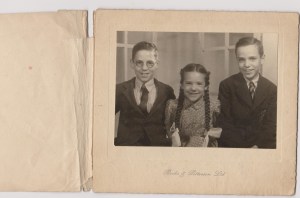
She completed her education in Holbeck at Crossflatts Primary school, and at Trinity Methodist Sunday School which she attended with her brothers. She retained to the end of her life deep resentment for the way John and David would each take a hand on the way to Sunday School, and see how far they could stretch her. And whether she could walk through lamp posts. Repeated experiments supported the theory that she couldn’t. Once they reached Sunday School they learnt how to be kind to each other, but by then it was too late.
Judith spent her childhood setting puzzles for the medical profession. She specialised in falling ill on holiday. Repeatedly. When she was 7 the family spent their holiday in Bridlington. Here she picked up an infection of the tear duct. She needed to return repeatedly to hospital in Leeds to have it drained. She would watch them cutting in to her eye. Once while on holiday in Blackpool seeing if he could make her ill this year, her cousin Peter dropped a large stone on her hand while they were playing in a rock pool. Later he spent about 60 guilt-ridden years believing that he had given her arthritis. To get her ready for later life, she was taken into hospital and stayed there for a week. Her mother stayed behind and got a job as waitress/cleaner at the Palm Court Methodist Holiday home where they were staying. She was visited by Rev Robert Wilfrid Callin. A rare distinction. The Rev Callin was a Primitive Methodist minister who was author of the hymn O Lord of Every Lovely Thing which found its way into the most excellent 1933 Methodist Hymn Book. One of his daughters, Jean Callin, was headmistress at her son Philip’s Middle School in Bradford.
Grandma Whiteley would take her to hospital appointments in Leeds General Hospital, and they would amuse themselves seeing how many people can you make smile? The hardest nut to crack was the local Congregational Minister who never got the hang of smiling. It is too late to teach him now. In time Judith was diagnosed as having a form of Rheumatoid Arthritis. She would go to Leeds General Hospital for regular examinations.
When she was about 10 years old, a friend of her mother suggested that she might like to spend a few weeks with her family on the Isle of Man. They had a small farm near Bride in the north of the island. It was a wonderful experience which never left her. Here she learned to milk a cow and gather eggs laid by the free ranging hens in the hedges. The family was as kind as you could ever imagine, and attended the local Methodist Chapel She was amused that on the Isle of Man, in the rural Sunday School, the children sang with great enthusiasm
Come, let us remember
The joys of the town,
Gay cars and bright buses
That go up and down.
Shop windows and playgrounds
And swings in the park,
And street lamps that twinkle
In rows after dark.
And they lived in Eden. In return, in Leeds at Harvest Festivals the men sang the Manx Fisherman’s hymn with equal commitment, claiming in open defiance of the evident truth
Our wives and children we commend to Thee
For them we plough the land and plough the deep
For them by day the golden corn we reap,
By night the silver harvest of the sea.
In Leeds?
She joined her 2 older brothers in Cockburn High School, famous for having taught Richard Hoggart. And her. She loved the school. She loved being in a mixed class, and came top of the class – the first time anyone had noticed that she was any good at anything.
 jbrip
jbrip 